

Upcoming Public Events
The Labor Day Launch:
Achieve a Major Goal in 8 Weeks
Starting September 1, 2025
Just $544
Registration is opening soon. Read more about the program here.
Jean’s method helped me to communicate, plan, organize, and execute better than any other methods I’ve found. Using Jean’s approach, I’ve been able to complete projects at Facebook that led to invitations to speak publicly and career promotion internally. I know I’m indebted to Jean for understanding how deeply your values ought to align with action to truly realize your ambition.
Is this you?
• You don’t mind working hard, but you hate discovering that your time was wasted.
• You are proud of having high expectations for yourself, but you notice that unrealistic expectations sometimes undercut your enjoyment of success.
• You try to focus on priorities, but you may still get bogged down in the minutiae of life.
You’re in the right place if you want to own your time so you can spend it on what matters most.
There is a dirty secret in all of those productivity systems you’ve tried out. They don’t work unless you adapt them to your particular situation. A new kind of “to do” list may be great advice—for someone with a different job description. A planning strategy might be useful—if you could clear an hour a week to implement it. A tracking system might make all the difference—if you didn’t find it overwhelming to maintain.
You probably know that setting unrealistic goals leads to predictable struggle. But it’s a lot easier to see that someone else’s goal is unrealistic than to set your own direction. It’s a lot easier to sit in an armchair and speculate on someone else’s mistakes than it is to untangle your own feelings. It’s a lot easier to blame failure on external factors than to see what changes you need to make to get a different result.
Other people’s productivity systems won’t work for you unless you understand how to apply their general ideas to your specific situation.
That takes thinking–thinking that no one can do in your place. Decision-making. Goal-setting. Problem-solving. All of these are needed to make your productivity system work for you.
To help make sense out of the conflicting time management advice, I’ve developed a simple model for developing productivity:
- When you take the right kind of action, Focused Action, you are assured of some success.
- With the right definition of success, Objective Success, your success will motivate you to put in another unit of effort.
- With the right kind of motivation, Authentic Motivation, your motivation will increase as a result of effort, not peter out.
When you integrate all three of these components, each one reinforces the others, making work easier, more motivating, and more successful. You create a virtuous cycle of productivity.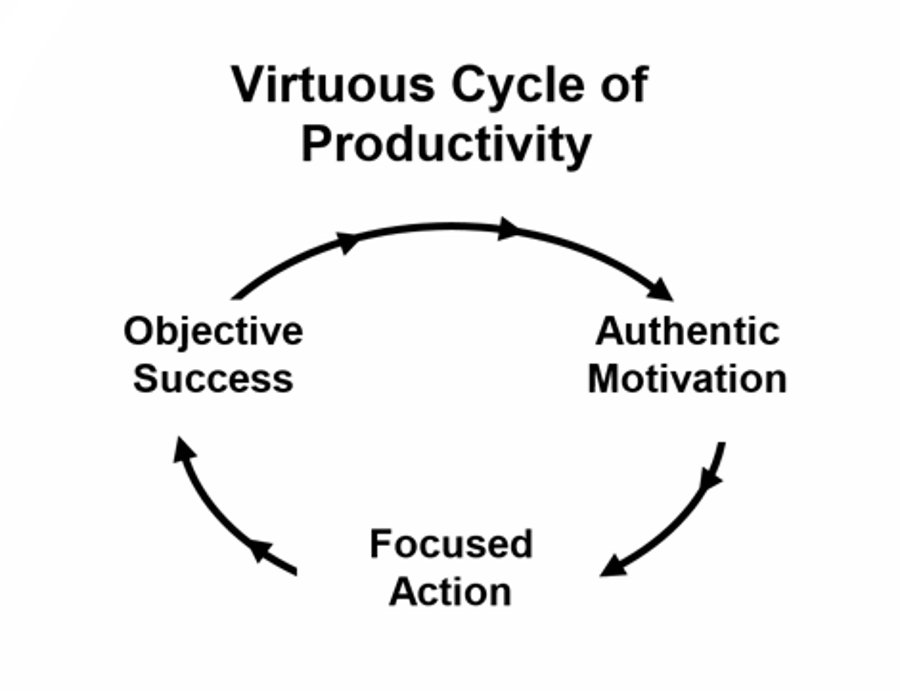
Learn more…
-
Get my free Thinking Directions Starter Kit
-
Join the Thinking Lab to get immediate access to self-study courses and more
-
Or just browse this page for video, blog posts, and testimonials from clients

Book Recommendation: The Posture Workbook
by Carolyn Nicholls
Much chronic pain can be eliminated by better posture, but good posture cannot be forced. Rules such as "stand up straight" and "don't slouch" can do more harm than good. Until it is fully automatized, a change in posture needs to be initiated and maintained...

The 3-Minute Walk
As soon as you finish reading this article, I recommend that you take out your smartphone, open the stopwatch app, start the timer, and then march out of the building. Keep going until the stopwatch hits 90 seconds, then turn around and come back. You will have...

When You Might Want to Procrastinate…
A while ago, I read an interesting book called The Magic Lamp: Goal Setting for People Who Hate Goals by Keith Ellis. Much of his approach is compatible with mine. Here is a clever tactic of his for using your skill at procrastination as a power for good. The problem...

So You Hate Your Job
I had an interesting conversation the other day with a Thinking Lab member who has hated his job off and on for a long time and wants to do something constructive about it. The key word here is "constructive." People "hate" all kinds of things: the culture, how their...

The Foundation for Managing Motivation
In order to gain power over your own motivation, you need a rational morality — a self-consistent morality — that guides all of your choices and actions in a way that enables you to live, productively and happily, in long-term loving relationships over the course of...
Brilliantly developed and taught by Jean Moroney, the Thinking Lab offers a comprehensive set of techniques to help you become highly effective at achieving your goals and values. The techniques range from clarifying and developing one’s long term goals and basic direction in life, right through to the day to day decisions and actions required to make those goals a reality. Jean Moroney and the Thinking Lab will help you define your dreams, then achieve them!
Jean’s classes offer you a lifetime value — the opportunity to gain increasing confidence in your ability to use your own mind. She offers guidance to help you plan your days so that they are deeply satisfying to you. She helps you set realistic ambitions for yourself and move into action. In this way, your days add up to achieving your important goals. Jean teaches skills to help you deal with internal conflict among values, to have empathy for yourself and for others, and much more. The personal exercises Jean offers help you incorporate the new principles and skills into your own life. Jean has a marvelous ability to listen to students and help them come up with solutions for many difficult internal struggles and life situations. She offers guidance everyone can use. Check out her website!